

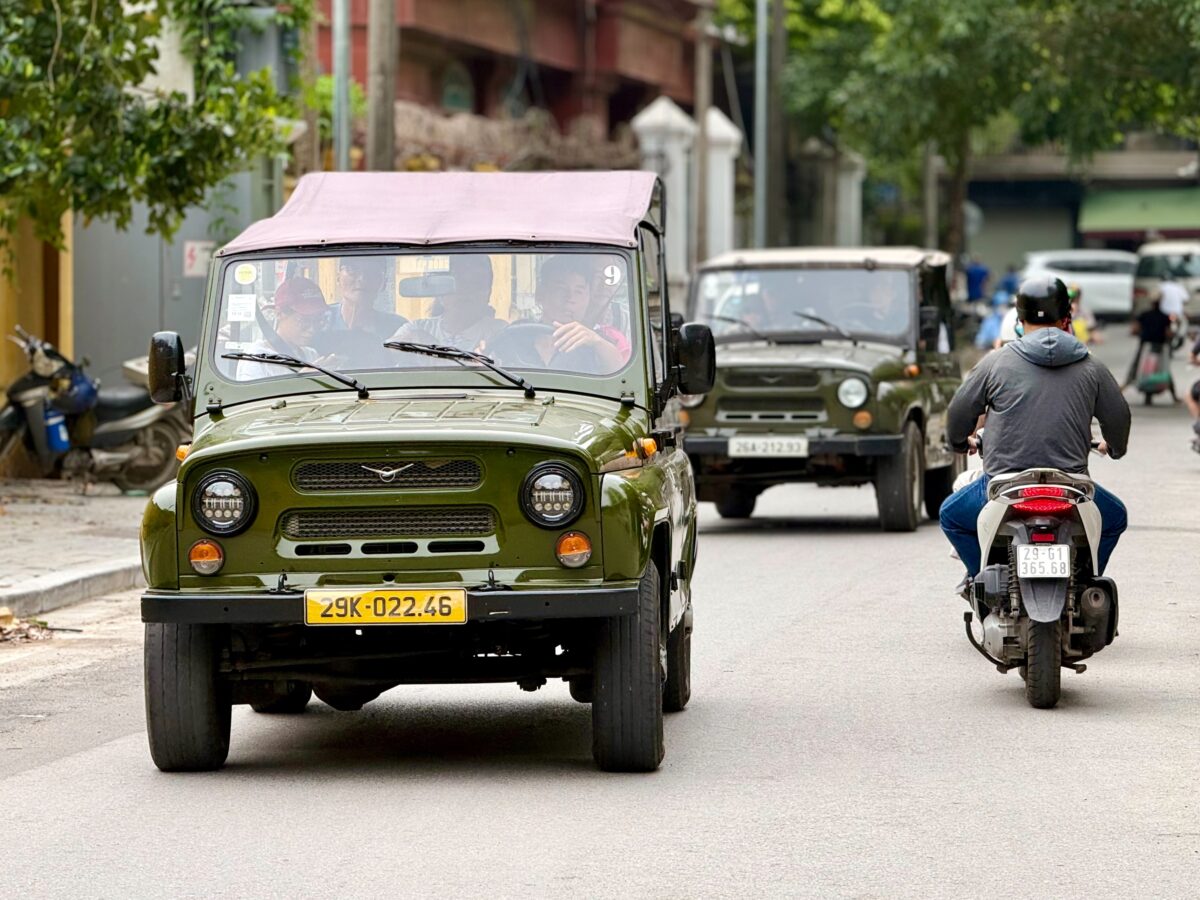
Hanoi Jeep Tour: Discover Authentic Local Culture
Hanoi is easy to recognize.
The Old Quarter has its narrow streets. Hoan Kiem Lake has its famous red bridge. The French Quarter has grand colonial buildings. Long Bien Bridge crosses the Red River, while West Lake stretches across the northwest side of the capital.
But recognizing Hanoi is not the same as understanding it.
The deeper character of the city is found in the spaces between the famous attractions: morning markets, family homes, neighborhood cafés, traditional food stalls, narrow residential lanes, small temples, riverside farms, workshops, and the everyday routines of people who have lived in Hanoi for generations.
A Hanoi Jeep Tour offers a practical way to see these different layers in one journey. Instead of staying within the main tourist streets, an open-air Jeep can connect historic landmarks with residential neighborhoods, hidden streets, lakes, markets, the Red River, and food stops. Current Hanoi Jeep itineraries combine places such as the Old Quarter, Ba Dinh, Huu Tiep Lake, Long Bien Bridge, Banana Island, West Lake, markets, and Train Street.
What Does “Authentic Hanoi” Actually Mean?
Authentic culture is not one particular attraction.
It is the way Hanoi functions every day.
It is a bowl of noodles eaten before work.
It is a coffee shop filled with residents rather than tourists.
It is a market opening early in the morning.
It is an older house standing beside a modern apartment building.
It is families gathering for dinner.
It is a small street temple hidden between homes.
It is farmers growing vegetables beside the Red River while Hanoi’s skyline rises behind them.
For travelers, these ordinary moments can be more revealing than visiting another major monument.
Begin With Hanoi’s Historic Core
The Old Quarter remains an essential part of the city’s identity.
Its streets developed around traditional trades, commerce, food, homes, and religious buildings. Today, the district combines historic architecture with restaurants, cafés, shops, markets, and intense street activity.
A Jeep allows you to experience the Old Quarter without spending the entire tour walking through it.
You can see how the dense historic center gradually changes as the vehicle moves toward other districts.
Watch Hanoi Change Street by Street
One of the most interesting aspects of a Jeep Tour is the transition between neighborhoods.
The commercial Old Quarter gives way to wider streets.
French colonial buildings appear.
Then come government and historical landmarks around Ba Dinh.
Further away, residential lanes become quieter.
Eventually, the city opens toward lakes, the Red River, and agricultural areas.
This geographic transition helps explain Hanoi better than seeing isolated attractions one at a time.
The French Quarter and Colonial Hanoi
The French Quarter provides a very different architectural character from the Old Quarter.
Wide boulevards, historic villas, government buildings, and the Hanoi Opera House reflect another period of the city’s development.
The contrast between the two areas is significant.
The Old Quarter feels dense, commercial, and intimate.
The French Quarter feels more spacious and formal.
Seeing both during one Jeep journey makes Hanoi’s architectural history easier to understand.
Ba Dinh: Where History Meets Everyday Hanoi
Ba Dinh is associated with some of Vietnam’s most important national landmarks.
The Ho Chi Minh Mausoleum, Presidential Palace, and Hanoi Flag Tower are among the major sights in this part of the city.
But the surrounding neighborhoods also contain ordinary homes, cafés, small businesses, and residential streets.
A good cultural tour should show both sides.
History is not separated from everyday life in Hanoi.
It exists alongside it.
Huu Tiep Lake and the B-52 Wreckage
Huu Tiep Lake provides an unusual example of how history remains embedded within ordinary neighborhoods.
The remains of a B-52 bomber can be seen in the lake.
What makes the location particularly striking is its setting.
There is no huge museum complex separating the visitor from the surrounding community.
Instead, historical memory exists beside homes, gardens, narrow streets, and everyday activity.
Current Hanoi Jeep Tours include Huu Tiep Lake and the B-52 wreckage as part of their city routes.
Hanoi’s Residential Alleys
Some of the best cultural observations happen when the Jeep leaves the main road.
Residential lanes reveal another Hanoi.
You may see children returning from school, residents chatting outside their homes, small repair businesses, neighborhood cafés, and families preparing meals.
These streets are not attractions.
That is exactly why they are interesting.
They show how the city functions when nobody is performing for visitors.
Small Shops Tell Big Stories
Look at the businesses along a residential street.
A tiny grocery shop may serve the same families every day.
A tailor may have operated in the same neighborhood for decades.
A café may be a gathering point for several generations.
A food stall may specialize in one dish and prepare it repeatedly throughout the day.
These businesses reveal the importance of community relationships in Hanoi’s urban life.
Traditional Markets
Markets are among the best places to observe everyday culture.
Instead of souvenirs, you see vegetables, fruit, meat, seafood, flowers, spices, household products, and prepared foods.
The experience can be particularly interesting in the morning, when markets are at their busiest.
Current Hanoi Jeep itineraries include market stops as part of broader cultural and sightseeing routes.
Hanoi’s Food Culture Is Part of Its Identity
You cannot separate Hanoi’s culture from its food.
Phở, bún chả, bánh cuốn, chả cá, bún đậu, bún ốc, bánh mì, chè, and egg coffee are not simply dishes for tourists to photograph.
They are part of the city’s everyday rhythm.
The way people eat is cultural information.
Breakfast can be quick and early.
Lunch may happen at a small restaurant near work.
Coffee can become a long social break.
Dinner can involve several shared dishes.
A Jeep Tour that includes food allows travelers to experience these routines rather than treating cuisine as a separate activity.
Phở and the Morning Routine
A bowl of phở can tell you a surprising amount about Hanoi.
Early in the morning, small restaurants fill with customers before the working day begins.
People sit together on simple stools, eat quickly, pay, and continue with their day.
The meal is uncomplicated.
The routine is deeply established.
For visitors, participating in that rhythm can be more meaningful than eating phở in a formal restaurant designed specifically for tourists.
Bún Chả and Hanoi’s Lunch Culture
Bún chả is another dish strongly connected with Hanoi.
Grilled pork, rice vermicelli, fresh herbs, and dipping sauce create a meal that is both simple and distinctive.
The smell of pork cooking over charcoal is one of the signatures of Hanoi’s food streets.
A guide can explain how the dish is eaten and why it has such a strong connection with the capital.
Egg Coffee and Café Culture
Hanoi’s coffee culture is another window into everyday life.
Cà phê trứng, or egg coffee, is particularly associated with the capital.
The drink combines strong Vietnamese coffee with a creamy egg mixture.
But the cultural experience goes beyond the drink itself.
Hanoians use cafés to meet friends, work, read, talk, and simply sit and watch the street.
A coffee stop therefore becomes a chance to observe social life at a slower pace.
Street Food Is Also Social Culture
Street food is not just about eating cheaply.
It creates social spaces.
People sit close together.
Tables are shared.
Conversation happens across groups.
Food preparation takes place directly beside customers.
The sidewalk becomes part restaurant, part meeting place, and part stage for daily life.
This is one of the most distinctive aspects of Hanoi’s urban culture.
Long Bien Bridge and the Red River
Long Bien Bridge provides a powerful connection between Hanoi’s history and geography.
The bridge is one of the city’s best-known historic structures, but its importance goes beyond photography.
Crossing toward the Red River reveals how the urban landscape changes.
The dense center gradually opens.
The river appears.
Vegetation becomes more prominent.
And the relationship between Hanoi and the Red River becomes easier to see.
Current Jeep routes use Long Bien Bridge as part of journeys connecting central Hanoi with riverside and agricultural areas.
Banana Island: A Rural Landscape Inside the Capital
One of Hanoi’s most surprising cultural contrasts is Banana Island.
Located in the Red River, the area contains agricultural land, gardens, paths, and farming activity despite being surrounded by a rapidly developing city.
For travelers, it can feel as though they have suddenly left Hanoi.
They have not.
They are simply seeing another side of the capital.
Current Jeep routes include Banana Island as one of the less conventional areas explored outside the main tourist circuit.
Hanoi’s Relationship With Agriculture
The Red River has shaped Hanoi’s development for centuries.
Even today, agricultural spaces remain close to the urban core.
This creates an unusual landscape where apartment buildings, bridges, roads, farms, and traditional communities can exist within the same visual frame.
For international visitors, this may be one of the strongest reminders that Hanoi is more than a dense historical city center.
West Lake and a Different Social Atmosphere
West Lake has a different personality from the Old Quarter.
The streets are generally more spacious.
There are cafés, restaurants, temples, residential neighborhoods, modern businesses, and lakeside roads.
The area is particularly interesting because it shows another side of contemporary Hanoi.
You can see how an old city has developed new lifestyles while retaining traditional elements.
Current Jeep itineraries combine West Lake with Truc Bach Lake, Tran Quoc Pagoda, residential areas, and other city highlights.
Truc Bach Lake
Truc Bach Lake sits beside West Lake and offers another perspective on Hanoi’s lakeside neighborhoods.
The smaller scale makes the area feel different from the larger lake.
Restaurants, homes, cafés, and historic sites surround the water.
It is an excellent example of how Hanoi’s lakes are not merely scenic attractions.
They are integrated into daily life.
Temples and Spiritual Life
Religion and spirituality remain visible throughout Hanoi.
Small temples can appear in residential neighborhoods.
Larger pagodas sit beside lakes.
Incense may burn near an entrance while traffic passes outside.
Tran Quoc Pagoda beside West Lake is one of the city’s most recognizable religious sites and can be incorporated into Jeep sightseeing routes.
But smaller neighborhood religious sites can be equally interesting because they remain closely connected to community life.
Traditional Architecture Beside Modern Buildings
One of Hanoi’s most distinctive visual features is architectural contrast.
A centuries-old religious building may stand a short distance from a modern apartment tower.
A narrow tube house may sit beside a French colonial villa.
A small family business may operate beneath a newly renovated building.
This mixture is not unusual.
It is Hanoi.
A Jeep allows you to see these contrasts continuously as you move through the city.
Tube Houses and Narrow Homes
Traditional Vietnamese tube houses are especially common in dense urban areas.
Their narrow street frontage and long layouts developed partly in response to historical land and taxation conditions.
Today, these houses often contain several generations, businesses, cafés, workshops, or a combination of uses.
Seeing them from street level helps visitors understand how Hanoi’s urban architecture evolved.
The Importance of Family
Family remains an important part of everyday Vietnamese life.
You may see multiple generations sharing a home.
Grandparents spending time with grandchildren.
Parents running a small business from the front of the house.
Families gathering for meals.
These scenes are easy to overlook if you are focused only on monuments.
A slower, neighborhood-focused tour creates more opportunities to notice them.
Hanoi’s Street-Level Conversations
One of the most authentic things you can observe is how people use public space.
People sit outside their homes.
Neighbors talk across doorways.
Friends meet at cafés.
Older residents gather in the morning.
Children play in small spaces.
Food vendors speak with regular customers.
The street is not simply transportation infrastructure.
It is part of the social environment.
Why the Jeep Is Useful for Cultural Exploration
A walking tour can take you deeply into one neighborhood.
A Jeep provides something different: range.
You can explore several districts in a few hours without spending most of the experience navigating traffic on foot.
The current Hanoi Jeep route combines major attractions with residential streets, markets, lakes, the Red River, Banana Island, and other less-visited areas.
That makes the Jeep particularly useful for travelers who want a broad understanding of Hanoi.
The Open-Air View Makes a Difference
The open Jeep format keeps you close to the environment.
You hear conversations.
You smell food.
You notice architectural details.
You see people sitting outside their homes.
You feel the temperature change as the route moves from crowded streets toward open areas.
The journey itself becomes part of the cultural experience.
You See the Transitions, Not Just the Attractions
This is one of the biggest advantages of traveling by Jeep.
Imagine starting near the Old Quarter.
Within the same journey, you can move through the French Quarter, Ba Dinh, residential neighborhoods, Long Bien Bridge, the Red River, Banana Island, and West Lake.
You are not simply collecting landmarks.
You are watching Hanoi transform around you.
A Cultural Tour Should Leave Room for Questions
The best cultural experiences are interactive.
Ask why houses are so narrow.
Ask why people sit on small stools.
Ask what families eat for breakfast.
Ask how Hanoi has changed.
Ask why certain neighborhoods are famous for particular foods.
Ask about the history of the Red River.
Ask about Vietnamese family traditions.
A knowledgeable guide can turn ordinary observations into meaningful cultural explanations.
Why a Women-Led Jeep Tour Can Feel More Personal
A women-led tour can add another human dimension to the experience.
Professional female guides can share perspectives on family life, food, education, work, traditions, neighborhood changes, and everyday experiences in Hanoi.
Current Hanoi Jeep Tours emphasize professional female guides, experienced drivers, small groups, food, cultural experiences, and access to areas beyond the main tourist route.
The tours are designed for everyone, including couples, families, solo travelers, and mixed groups.
What Does “Local” Mean on a Cultural Tour?
It should not mean simply taking visitors somewhere obscure.
A meaningful cultural experience should have context.
Why is this market important?
Why does this street have a particular food?
Why are these homes designed this way?
Why do people gather around the lake?
Why is the Red River important?
Without those explanations, a hidden street is just another street.
With context, it becomes part of Hanoi’s story.
A Typical Cultural Jeep Journey
A four-to-four-and-a-half-hour experience can begin in central Hanoi before moving through historic neighborhoods.
The Jeep can continue toward Ba Dinh and Huu Tiep Lake, then travel toward Long Bien Bridge and the Red River landscape.
From there, the route can explore Banana Island or other quieter areas before continuing toward West Lake, Truc Bach, and the Old Quarter.
Current city Jeep routes follow a similar combination of major landmarks and lesser-visited environments, with morning, afternoon, and evening departures.
Morning Is Excellent for Culture
Morning is arguably the best time for travelers interested in everyday routines.
Markets are active.
Food vendors are preparing breakfast.
Residents are heading to work.
Children are going to school.
The city is already busy but not yet dominated by the evening entertainment atmosphere.
If your goal is to observe daily life, a morning departure can be particularly rewarding.
Afternoon Shows Another Hanoi
The afternoon provides a different rhythm.
Lunch activity begins to slow.
Cafés become popular.
Traffic remains busy.
The warmer light can be excellent for photography.
An afternoon Jeep Tour can also finish near the Old Quarter, allowing you to continue exploring independently afterward.
Current published Jeep schedules list afternoon departures around 1:00 PM and ending around 5:30 PM.
Evening Reveals Hanoi’s Social Side
At night, the focus changes from work to social life.
Restaurants fill.
Street food becomes prominent.
Cafés remain busy.
Hoan Kiem Lake becomes a gathering place.
The Old Quarter becomes more energetic.
A nighttime Jeep Tour is therefore particularly useful for travelers interested in Hanoi’s food culture and evening atmosphere.
What About Families?
A Jeep can be an excellent format for families because it reduces the amount of walking required between distant areas.
Children can experience historic landmarks, bridges, markets, food, lakes, and rural landscapes without spending the entire day walking through crowded streets.
The changing scenery also keeps the experience varied.
What About Couples?
For couples, a private Jeep experience provides an easy way to combine sightseeing and food without following a rigid large-group schedule.
The open-air vehicle is also excellent for photography.
You can move from the historic center to lakes and riverside landscapes while seeing Hanoi transition from one neighborhood to another.
What About Older Travelers?
The Jeep is particularly practical for travelers who want cultural discovery without an exhausting walking itinerary.
You can remain seated while traveling between districts and get out only for selected stops.
This creates a more comfortable balance between sightseeing and exploration.
What Should You Wear?
Comfortable clothing and walking shoes are recommended.
Hanoi can be hot and humid, particularly during the summer.
A light rain layer is useful because weather can change quickly.
For temple and pagoda visits, modest clothing is appropriate.
Since the Jeep is open-air, you are exposed to the weather rather than traveling inside a fully enclosed vehicle.
What About Rain?
Current Hanoi Jeep Tours operate in rain or shine and provide rain ponchos, while the Jeeps have retractable roofs.
The exact route can be adjusted when weather conditions affect particular stops.
What Makes This Better Than a Conventional City Tour?
A conventional city tour often focuses on the question:
What are the most important sights in Hanoi?
A cultural Jeep Tour asks:
How does Hanoi actually work?
That changes what you notice.
Instead of simply photographing a building, you observe the street around it.
Instead of simply crossing Long Bien Bridge, you look at the river landscape and communities beyond it.
Instead of simply visiting West Lake, you observe how residents use the lake and surrounding neighborhoods.
Instead of simply eating Vietnamese food, you learn where and when people eat it.
The Journey Connects the Stories
The Old Quarter explains commerce.
The French Quarter explains colonial history.
Ba Dinh explains national history.
Huu Tiep Lake reveals wartime memory.
Long Bien Bridge connects Hanoi to the Red River.
Banana Island reveals agriculture.
West Lake shows another side of modern urban life.
Food connects all of these places to everyday routines.
The Jeep becomes the thread connecting the stories.
Authentic Culture Is Often Ordinary
Perhaps the most important lesson is that culture does not always look spectacular.
A bowl of noodles can be cultural.
A morning coffee can be cultural.
A market can be cultural.
A family eating together can be cultural.
A narrow house can be cultural.
A farmer working near the city can be cultural.
These ordinary moments are what make Hanoi feel alive.
Final Thoughts
A Hanoi Jeep Tour: Discover Authentic Local Culture is ideal for travelers who want more than a checklist of famous attractions.
The Old Quarter and Hoan Kiem Lake are important, but they are only the beginning.
Beyond them are residential alleys, traditional markets, neighborhood restaurants, historic homes, lakeside communities, Huu Tiep Lake, Long Bien Bridge, the Red River, Banana Island, West Lake, temples, cafés, and countless everyday scenes that reveal how Hanoi actually functions. Current Jeep routes deliberately combine these cultural environments with the city’s major landmarks.
The greatest value of the experience is not simply seeing more places.
It is understanding the connections between them.
You see where people live, where they eat, where they work, where they socialize, how the city developed, and how old traditions continue alongside modern Hanoi.
That is the difference between visiting Hanoi and experiencing Hanoi.
Hanoi Jeep Tours – Led by Women
Address: 91 Tho Nhuom Street, Hoan Kiem District, Hanoi, Vietnam
WhatsApp: +84 982 416 518 / +84 981 090 989
Email: toursjeephanoi@gmail.com
Official Website: Hanoi Jeep Tours – Official Website
Current city Jeep experiences are available in morning, afternoon, and evening formats, with routes combining Hanoi’s historic center, hidden neighborhoods, lakes, markets, Long Bien Bridge, the Red River, Banana Island, and other cultural highlights.