

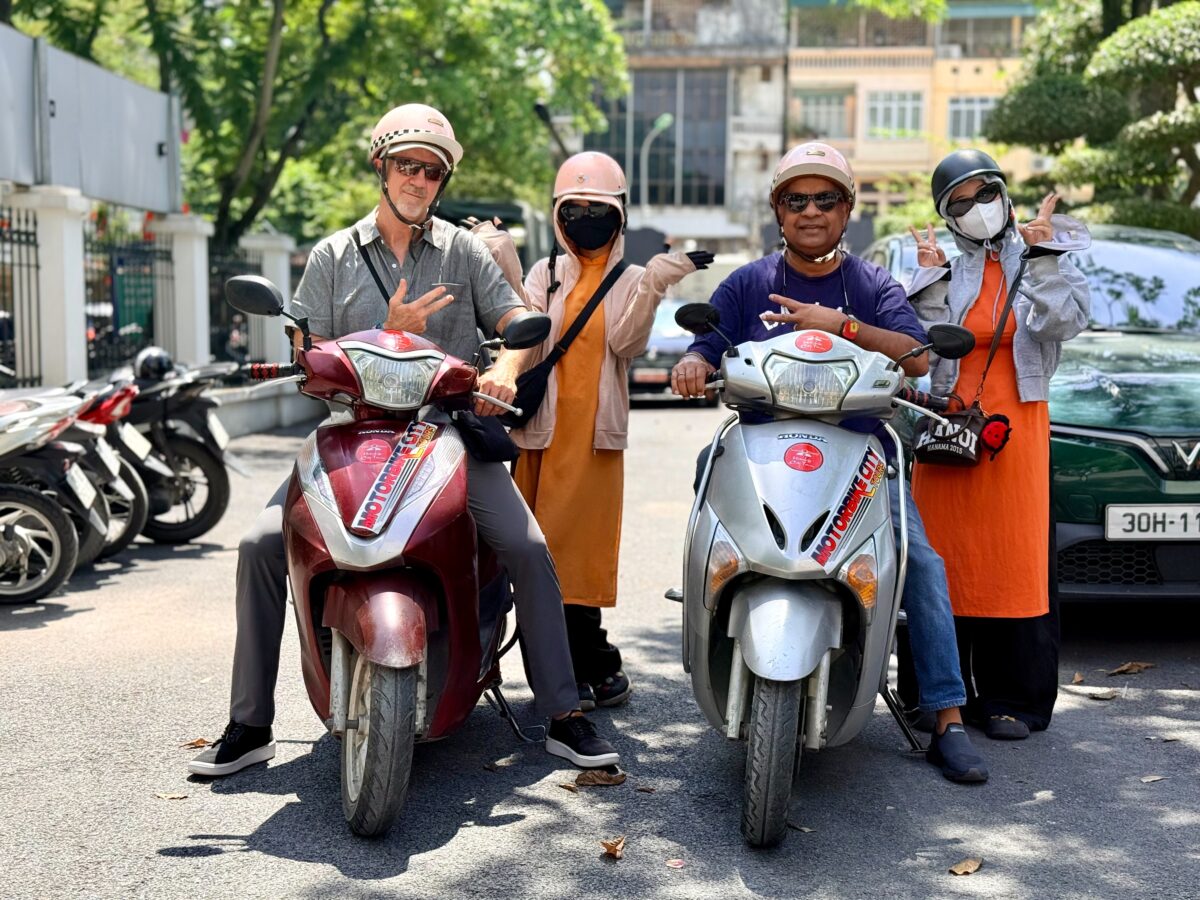
Hanoi Vespa Tour for Street Photography Enthusiasts
Hanoi is a dream destination for street photographers. The city changes constantly from one street to the next: an old woman arranging flowers outside her home, a coffee seller preparing the first cup of the morning, scooters flowing through an intersection, a market opening at sunrise, or golden light falling across the Red River.
A Hanoi Vespa Tour for Street Photography Enthusiasts makes it easier to photograph these scenes because you can move quickly between different neighborhoods without spending the entire day walking. Instead of following only the standard tourist route, a Vespa can take you through narrow streets, markets, residential areas, lakeside neighborhoods, historic districts and countryside communities where everyday Hanoi becomes the subject.
Current Vintage Vespa itineraries from Asia Vespa Tours include areas such as the Old Quarter, French Quarter, Long Bien Bridge, Red River communities, West Lake, Truc Bach Lake, Banana Island and local neighborhoods, depending on the selected route.
Why Is a Vespa Good for Street Photography?
Street photography is often about being in the right place at the right moment.
A walking photographer may spend 30 minutes reaching another neighborhood. A car can get there faster, but traffic and parking can make spontaneous stops difficult.
A Vespa offers a useful middle ground.
You can travel relatively quickly between locations while remaining exposed to the street. When your guide sees an interesting scene, you can stop, get off and photograph it.
This is particularly useful in Hanoi, where visually interesting moments happen throughout the day.
Photograph Hanoi Beyond the Famous Landmarks
The best Hanoi photographs are not necessarily pictures of famous attractions.
A street photographer may be more interested in:
- A neighborhood market
- A flower vendor
- An old storefront
- A traditional Vietnamese house
- A street food stall
- A local café
- Children playing in an alley
- Workers preparing food
- Cyclists carrying flowers
- Farmers near the Red River
- Hanoi residents having morning coffee
A local guide can help you reach these environments while explaining what you are seeing.
The Old Quarter: A Street Photographer’s Playground
The Old Quarter is one of the easiest places to find photographic subjects.
Narrow streets are packed with shops, cafés, restaurants, vendors and residential buildings.
The visual variety is enormous.
One street may specialize in a particular product while the next is filled with food stalls or small workshops.
For photographers, this creates a constant stream of potential compositions.
A Vespa also allows you to move beyond the most photographed streets and explore smaller lanes nearby.
Early Morning Hanoi Photography
Morning is one of the best times for street photography.
The city is waking up, markets become active and restaurants begin preparing breakfast.
There are fewer tourists in many areas, while local activity is already intense.
A sunrise or early-morning Vespa experience can therefore be particularly attractive to photographers.
The current Hanoi Sunrise Vintage Vespa Tour operates approximately 5:30 AM–8:30 AM from April to October and 6:00 AM–9:00 AM from November to March, with breakfast and café stops included.
The early start is worth considering if your priority is authentic street photography rather than sleeping late.
Photograph Hanoi’s Morning Markets
Markets provide some of the richest photographic opportunities.
You can photograph textures, colors, movement and human interaction all in one location.
Look for details rather than simply photographing the entire market.
A close-up of herbs, hands preparing food, a vendor arranging vegetables or an old bicycle loaded with produce can tell a stronger story than a wide photograph.
Your guide can also help explain what you are photographing.
Long Bien Bridge
Long Bien Bridge is one of Hanoi’s most recognizable photographic locations.
The bridge offers views of the Red River, railway infrastructure, passing traffic and changing urban landscapes.
From a photography perspective, it provides opportunities for both wide landscape compositions and detailed documentary images.
Current city and countryside Vespa routes include Long Bien Bridge as a major stop.
Photograph the Red River
The Red River provides a completely different visual atmosphere from central Hanoi.
Depending on the route, you may encounter gardens, banana plantations, agricultural areas, paths and communities along the river.
The contrast between Hanoi’s dense urban center and its nearby agricultural landscape can produce a compelling photo story.
Current countryside Vespa itineraries specifically include Red River Delta villages and agricultural areas.
Banana Island
Banana Island is another interesting location for photographers.
It offers greenery and agricultural landscapes surprisingly close to central Hanoi.
Instead of photographing skyscrapers and traffic, you can capture plants, farmers, paths, bicycles and rural scenes.
Current daytime Vespa routes include Banana Island on selected itineraries.
West Lake Photography
West Lake provides a different visual palette.
The lake, trees, cafés, residential streets and temples create opportunities for calmer photographs.
Early morning can be especially interesting when residents exercise, walk, cycle or gather around the lake.
For photographers, West Lake can provide a useful contrast to the density of the Old Quarter.
Truc Bach Lake
Truc Bach Lake is smaller and more intimate than West Lake.
The surrounding streets contain cafés, restaurants, homes and local businesses.
This makes it useful for environmental portraits and documentary-style photography.
A Vespa tour can combine Truc Bach and West Lake with other parts of Hanoi rather than treating them as isolated destinations.
French Quarter Architecture
Street photography does not have to mean photographing people.
Hanoi’s French Quarter provides excellent opportunities for architectural photography.
Look for:
- Colonial façades
- Shutters
- Balconies
- Tree-lined streets
- Old doors
- Architectural details
- Shadows
- Contrasts between old and new buildings
The challenge is to combine architecture with everyday life.
A person cycling past an old colonial building can make a stronger photograph than an empty façade.
Train Street Photography
Train Street is one of Hanoi’s most photographed locations.
The narrow railway corridor surrounded by homes and cafés creates an unusual urban environment.
However, it is important to remember that this is an active railway.
Access and viewing conditions can change, and photographers should follow current local restrictions and their guide’s instructions rather than entering restricted areas or standing on the tracks.
The current Asia Vespa Tours city itinerary includes Train Street among selected sightseeing stops.
Street Food Photography
Food photography and street photography naturally work together in Hanoi.
A small bowl of Phở, steam rising from a pot, a Bún Chả grill, a vendor preparing Bánh Cuốn or a cup of Egg Coffee can become a strong documentary image.
The advantage of having a local guide is that you can discover food stalls and family-run establishments while learning what you are photographing.
Current Vespa food-tour itineraries focus on local food and drinks alongside neighborhood exploration.
Photograph People Respectfully
The human element is often the heart of Hanoi street photography.
But taking photographs of people requires sensitivity.
A simple smile and gesture toward your camera can be enough to ask permission.
If someone looks uncomfortable, don’t take the photograph.
For portraits, asking first often produces a better experience for everyone—and sometimes a better photograph because the subject knows what you are doing.
Photograph Details, Not Just People
Try looking for small visual stories.
For example:
Hands + food + cooking fire
Bicycle + flowers + morning light
Old doorway + resident + shadow
Coffee cup + street + passing scooters
Market stall + colorful produce + vendor
These combinations can tell a much stronger story about Hanoi than a collection of tourist landmarks.
Use the Vespa as a Photography Tool
The Vespa itself can become part of the story.
A photograph of your rider waiting beside an old building, a vintage Vespa parked near a market or the scooter reflected in a shop window can create a distinctive travel image.
The vehicle becomes part of your visual narrative rather than simply transportation.
What Camera Should You Bring?
You don’t need professional equipment.
A mirrorless camera, DSLR or high-quality smartphone can all work well.
For a dedicated street photographer, a compact setup is usually better than carrying a large amount of equipment.
You want to be able to move quickly.
A practical setup might include:
- One camera body
- 28mm or 35mm equivalent lens
- Extra battery
- Extra memory card
- Small camera bag
- Lens cloth
- Smartphone for quick shots
A 35mm-equivalent lens is particularly versatile for environmental portraits and everyday street scenes.
Is a Wide Lens Better?
A wide lens can be useful for Hanoi’s narrow streets.
A 24mm or 28mm equivalent allows you to capture more of the environment.
This is useful when photographing people within their surroundings.
However, getting too close can make portraits feel intrusive.
A 35mm or 50mm equivalent gives you more separation while still retaining environmental context.
Should You Bring a Telephoto Lens?
Usually, you don’t need a large telephoto lens for a Vespa photography tour.
It adds weight and can make the camera harder to handle while moving between stops.
A compact zoom can be a good compromise if you want flexibility.
Smartphone Photography Works Surprisingly Well
Don’t underestimate your phone.
Modern smartphones are excellent for street photography, particularly in bright Hanoi conditions.
They are also less intimidating when photographing everyday scenes.
A smartphone can be especially useful for quick photographs while your main camera remains packed away.
Photography at Different Times of Day
Hanoi changes dramatically throughout the day.
Sunrise
Soft light, quiet streets, markets and early commuters.
Morning
Strong street activity, food preparation and local businesses opening.
Afternoon
More intense light, deeper shadows and busy streets.
Sunset
Warm light around lakes, bridges and urban neighborhoods.
Night
Street food, neon signs, headlights, cafés and lively streets.
This is why choosing the right departure time is almost as important as choosing the route.
Golden Hour on a Vespa
The late afternoon can be particularly attractive for photographers.
Warm light can transform old buildings, streets and people.
The current sunset/night Vespa experience runs into the evening and combines sightseeing with Hanoi after dark.
For photographers who enjoy both daylight and night photography, this can be an excellent format.
Night Street Photography
Hanoi becomes a completely different photographic subject after sunset.
Street food stalls glow under artificial lights.
Motorbike headlights create movement.
Cafés become bright pockets of activity.
The Old Quarter becomes particularly energetic.
Night photography requires different camera settings, but the visual rewards can be significant.
Photographing From the Moving Vespa
You can take photographs while riding, but you should prioritize safety.
Do not lean into traffic or suddenly raise a camera in a way that distracts the rider.
The better approach is to photograph when the Vespa has stopped.
Your guide can help identify places where you can safely get off and photograph.
Don’t Try to Photograph Everything
One common mistake is taking hundreds of photographs without really seeing anything.
Give yourself time to observe.
Instead of photographing every street, look for a theme.
For example:
“Morning life in Hanoi.”
Or:
“Traditional food in modern Hanoi.”
Or:
“Old and new Hanoi.”
A focused photographic story is often much more memorable than hundreds of unrelated images.
A Sample Photography-Focused Vespa Route
A photography-oriented half-day itinerary could include:
8:00 AM: Hotel pickup.
8:15 AM: Old Quarter street photography.
9:00 AM: Local market and breakfast.
9:45 AM: French Quarter architecture.
10:15 AM: Long Bien Bridge.
10:45 AM: Red River communities or Banana Island.
11:45 AM: Local lunch or coffee.
12:30 PM: Return to the hotel.
The exact route can be adapted according to weather, photography interests and road conditions.
Can You Request Photography Stops?
This is one of the main advantages of a private tour.
If you see an interesting location, you can ask your rider to stop when it is safe.
A private itinerary can also spend more time in neighborhoods that interest you.
For serious photographers, this flexibility can be more valuable than simply having a longer list of attractions.
Private or Group Vespa Tour for Photographers?
For casual photography, a group tour can work well.
For serious street photographers, private is usually better.
A private tour gives you more control over:
- Time spent at each location
- Photography stops
- Route
- Departure time
- Food stops
- Lighting conditions
- Subject preferences
If photography is the primary purpose of your Hanoi visit, the additional cost can be worthwhile.
Hanoi Vespa Tour Photography Tips
Keep your camera accessible but secure. Watch the light constantly. Photograph layers rather than isolated objects. Look for reflections in shop windows and puddles. Use shadows to create depth. Include people to show scale. Photograph both wide scenes and details. Don’t spend the entire tour looking through the viewfinder. And most importantly, let your local guide know that photography is one of your main interests.
What Should You Wear?
Wear comfortable clothing that allows you to move easily.
Closed shoes are preferable.
Avoid loose camera straps that could become uncomfortable while riding.
A lightweight jacket can be useful during early-morning or evening tours.
Rain protection is provided on current Vespa itineraries when needed.
Is a Hanoi Vespa Tour Safe for Camera Equipment?
Generally, yes, if you carry your equipment carefully.
A small padded camera bag is preferable to a large backpack.
Keep your camera secure while riding and only remove it when the Vespa has stopped.
A simple shoulder strap or compact camera bag can make changing locations much easier.
What Does a Photography Vespa Tour Cost?
Current published Asia Vespa Tours prices provide several options.
The 2.5-hour Vintage Vespa Tour starts at around US$45, while the standard city and countryside tours are around US$50 per person. A food-focused Vespa experience is approximately US$59, while a full-day city-and-countryside experience is around US$99 for the published group option.
A private tour costs more but can be especially valuable for photographers because the itinerary can be more flexible.
What Is Included?
Depending on the selected experience, the price can include:
- Vintage Vespa
- Professional rider
- English-speaking guide
- Hotel pickup and drop-off
- Helmet
- Rain protection
- Food
- Drinks
- Lunch or dinner
- Insurance
Current published tour information confirms these inclusions vary by itinerary, so travelers should check the exact package before booking.
Should You Book a Sunrise or Sunset Tour?
Choose sunrise if you want quiet streets, markets, early local activity and soft natural light.
Choose sunset if you prefer warm architectural light followed by Hanoi’s energetic nightlife.
Choose a daytime tour if you want maximum flexibility and strong natural light.
Choose a night tour if your photography focuses on food, people, neon and urban atmosphere.
Is Hanoi Good for Street Photography Beginners?
Absolutely.
Hanoi is visually rich without requiring you to travel far from the center.
You can practice composition, portraits, architecture, low-light photography and documentary photography within a relatively small area.
A local guide also reduces the stress of finding locations yourself.
Is It Good for Professional Photographers?
Yes, especially if you book privately.
A professional photographer may want specific subjects such as:
- Traditional crafts
- Local markets
- Architecture
- Rural life
- Food preparation
- Environmental portraits
- Street transportation
- Urban development
- Night photography
A private Vespa can provide the mobility needed to build a more coherent photographic project.
The Local Guide Can Improve Your Photography
This is often overlooked.
A guide doesn’t just take you from one location to another.
They can tell you where to look.
They may notice a market that is particularly active, a quiet neighborhood with interesting architecture or a local event that you would otherwise miss.
That local awareness can dramatically improve the photographs you return home with.
Why Women-Led Tours Can Be Interesting for Photographers
A women-led Vespa experience adds another layer of local interaction.
Your guide can introduce you to everyday life from her own perspective and explain details about family, food, work and neighborhood culture.
For documentary photographers, these conversations can provide context that makes photographs more meaningful.
The current Asia Vespa Tours concept combines women riders with local cultural experiences and neighborhood exploration.
Final Verdict
A Hanoi Vespa Tour for Street Photography Enthusiasts is an excellent way to combine mobility, local culture and photography.
The Vespa lets you cover more ground than a walking tour, while the open-air experience keeps you connected to the street. With a local guide, you can go beyond the obvious tourist attractions and discover markets, alleys, neighborhoods, food stalls, lakes, bridges and countryside landscapes that provide richer photographic stories.
For casual photographers, a standard half-day tour can be enough.
For serious photographers, a private tour timed around sunrise or sunset is the stronger choice.
The best photographs in Hanoi are often not the famous ones.
They are the photographs of ordinary people doing ordinary things—a bowl of noodles steaming at breakfast, flowers being carried through an alley, an old man drinking coffee, a market opening at dawn or a farmer working beside the Red River.
A Vespa simply gives you a better chance of being there when those moments happen.
Book a Hanoi Vespa Photography Experience
Asia Vespa Tours — asiavespatours.com offers Vintage Vespa city, countryside, food, sunrise, sunset and full-day experiences suitable for travelers who want to explore Hanoi at street level.
Asia Vespa Tours — asiavespatours.com
24/7 WhatsApp: +84 982 416 518
Email: info@asiavespatours.com
Bring your camera, choose the right light, and let Hanoi become the story you photograph.